A Colorful Water Properties Lab

Updated: 2 days ago

Do this demonstration with younger kids and they will really be wowed at the end result. Older kids will too if they have never done this before. It will make them think that the properties of water are pretty cool, which to us science people, we certainly think so. This lab will explore the process of capillary action. Capillary action is the process by which water rises without help from any outside forces. In plants, this occurs when water from soil is drawn up roots and into the xylem tissue against the force of gravity.
Capillary action is covered in biology in the plants unit when transpiration is being covered. Transpiration is the pulling of water and dissolved nutrients from the soil, up the roots and into xylem tissue. This water eventually reaches the stem and leaves and then turns into water vapor as it exits the plant through tiny pores in the leaves called stomata. Capillary action requires three important water properties to happen: adhesion, cohesion, and surface tension.
Materials
Five, clear, plastic cups
Water·
Food coloring (Red, Yellow, Blue)
Four, half-sheet paper towels (Folded)
Spoon
The Set Up
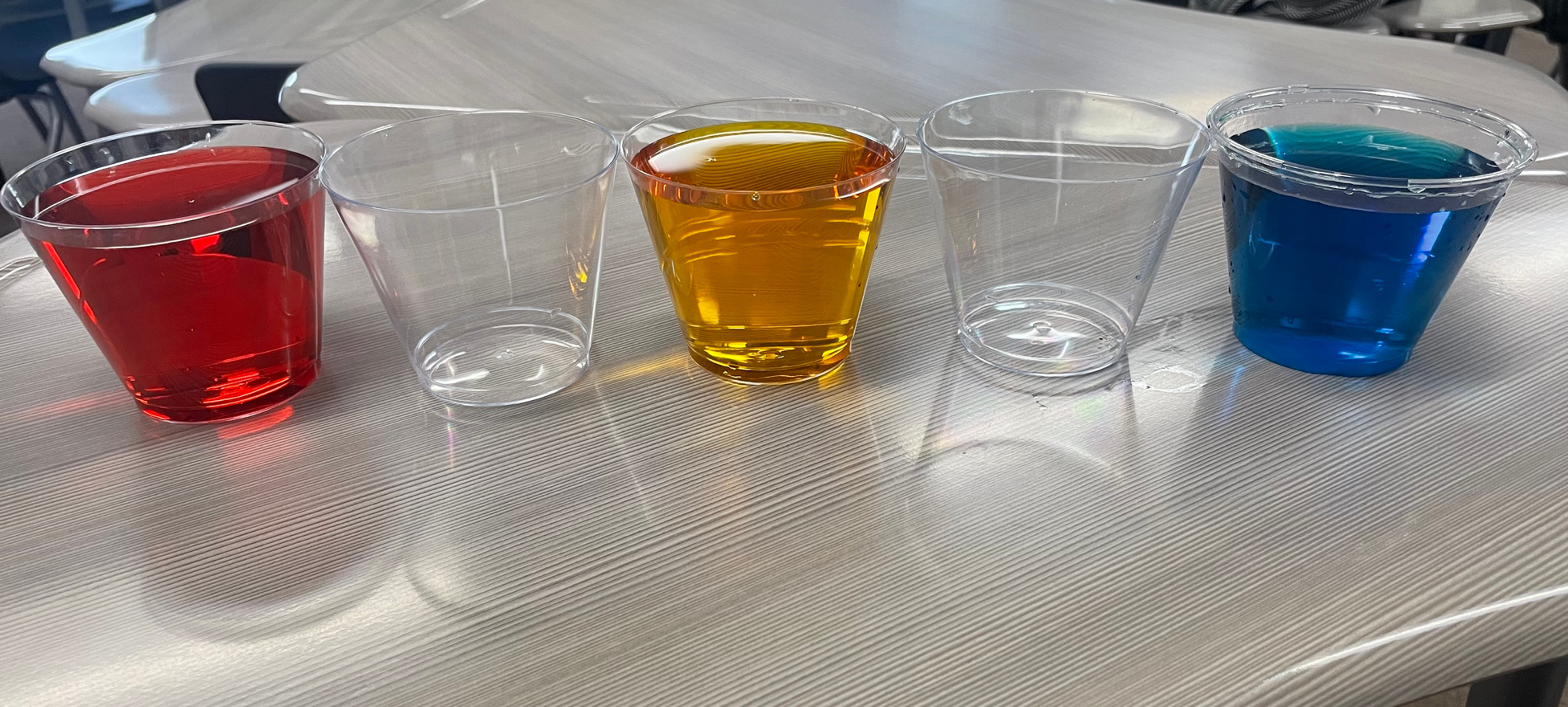
1. Line up five clear, plastic cups in row as close to each other as possible.
2. Add water to every other cup (Cup 1,3, and 5). Fill to the rim. Leave cup 2 and 4 empty, as
shown in the picture.

3.Next, add a few squirts of food coloring in the cups that have water. Any color is fine, but do
not use the same color in cups next to each other. I like to use red in the first cup. Yellow in the
third cup and blue in the fifth cup, like in the picture below. You can buy food coloring off of
Amazon or at the grocery store, too.
4. Using a different spoon for each cup, stir the food coloring in the water so it mixes evenly. If you want to use the same spoon, be sure to wipe the spoon clean with a paper towel before stirring the water in the other cups.
5. Fold four half-sheets of paper towel into a narrow strip like that shown below (About an
inch wide).
6. Fold the paper towel in half so it makes a V shape. The V should be about the size
of your plastic cups. You can trim the ends of the V with scissors to shorten it. Of course, if it is a little longer, it will still work. You can see in the picture below the red towel was a little higher than the rest. You can push it down a bit if this happens if you want. It will work either way.
7. One V-shaped paper towel will be used to connect two adjacent glasses. To do this, flip the V
shaped paper towels upside down, so the two points of the V are facing down in the cups. Put one V end in each cup as you see in the picture below. Do not touch the cups or paper towels once the lab is set up.
8. Students will observe what they see happening once the V-shaped paper towel ends are positioned in each cup. Students will notice that the more time that passes, more color change occurs.

As stated earlier, the water properties of adhesion, cohesion, and surface tension all make capillary action possible. Water molecules are wonderful at sticking to each other (This is cohesion) and wonderful at sticking to other surfaces (This is adhesion). Adhesion causes the water molecules at the edge of the paper towel to stick to the paper towel fibers, while cohesion is responsible for dragging, or pulling, the rest of the water molecules up with the ones that have adhered to the paper towel. The water molecules, in a way then, through adhesion and cohesion "climb" up and down the paper towel, bringing water into the nearby empty cups, filling them up with water.
Surface tension plays a role in capillary action as well. Because water molecules are cohesive, the top of the water column forms a tight, single sheet or layer. Surface tension is the pulling force that holds the water's surface intact and helps to draw up water molecules in a tube or narrow surface, or in this case the paper towel fibers (capillary action).
In class you might have about 30 minutes time to see the effects. Leave one experiment overnight to show students the effects the next day. It will be a big difference. You will probably see the full effect after 4-5 hours. If you want to try other water property activities, check out these labs: Penny Lab and Floating Paperclips.
Extension
Place a celery stalk in a cup of water that has food coloring mixed in it. Let students observe capillary action in the celery stalk.
Place a single white carnation with its stem in a cup of food coloring mixed in it. Before you place it in the water, trim the bottom about 2 inches at a 45-degree angle. Wait a few days to see results.