Clay Integumentary System Model
- The Biology Buzz Place

- Feb 8
- 3 min read
Updated: Jul 25

Okay, for all the art loving students and teachers out there, here is my latest human body system clay model. This one is on the integumentary system. Like the other clay models I posted about previously, you will find this one is also relatively easy to do. I know I say this a lot, but it is true and I have seen it as a teacher-most students will enjoy learning science more when you include fun lessons like this. They are also more likely to retain the information when they can visualize it as with a handmade model. It makes learning so much more engaging and students can tap into their creative side.
The integumentary system is the body system that involves the skin and all the different structures in skin. Students are often surprised to learn that there is so much going on in their skin. The skin has many important functions that help keep our bodies in homeostasis, like regulating body temperature, providing a protective barrier against pathogens, detecting changes in the environment through skin receptors, and more! It really is a fascinating body system.
Let’s dive into how to make this model. Your model will include the following parts:
Epidermis layer (purple)
Dermis layer (beige)
Hypodermis layer (yellow)
Hair follicle (brown)
Hair shaft (brown)
Sebaceous gland (white)
Nerves (nerves)
Blood vessels- artery (red) and veins (blue)
Sweat gland (pink)
*Use a different color clay for EACH part listed above, as shown in the picture.
In this picture of one of the integumentary system models, you will see that to begin making it you will first need to get three different colors of big pieces of clay. These will become your three different skin layers, or sections. Then with your hand or a shaping tool, you will flatten them. You do not want it to be too thin, but not too thick either.
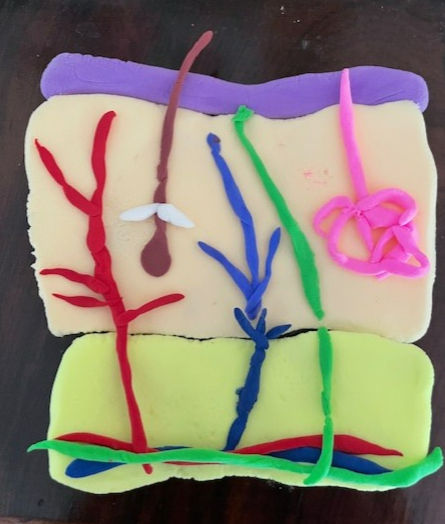
You will want to make the layers to scale size. The epidermis (top section of the skin, purple in the picture) will be the thinnest layer, the hypodermis, the deepest section of the skin, (yellow in the picture) will be a wider than the epidermis, but less wide than the dermis, and the dermis (middle section, beige in picture) will be the widest of all the layers. After you have these layers made, you will attach them to each other, by carefully molding them in so that they blend in together, slightly.
Once you have your skin layer background, now you are ready to begin attaching the parts that go in them: Choose a different color of clay for EACH part, as I did and I indicated above. Some of the parts might be tricky to make like sweat glands. Take your time and be patient and it should turn out fine.
Once finished, set the model aside to air dry a few hours. Before or after students make their models, they can write in the functions of each part. I have a free worksheet on this for this model. You can also print out these free labels for this model. Students can cut out the labels and glue them to toothpicks then use this to identify the parts on their model.
While teaching this clay model activity, you may want to bring up the topic of taking care of your skin and developing regular, daily habits to protect your skin from skin damage and harmful UV rays. Most people know they must protect their skin in the summer when spending a day at the beach or water park by wearing sunscreen and hats and sunglasses, but what about year-round skin care?
I have an Integumentary System PDF presentation that includes student note pages, and a "Fun in the Sun Skit" that I made up that covers skin safe habits in the sun
(You didn't know I was a playwriter too, did you? :)).


